
Surgical Orthodontics
What Is Surgical Orthodontics?

It is called orthognathic surgery. It is used to treat severe cases of teenagers and adults with bad bites, jaw bone abnormalities, malocclusion, or other aesthetic concerns (i.e. want to change the position of chin forward or back). The necessity for surgical orthodontics occurs when the jaws do not line up correctly, and a proper bite cannot be achieved with orthodontic treatment alone. The sequence of treatment is this: orthodontics is initiated to align the teeth so that the jaws will fit properly after surgery. Once the teeth are in an acceptable position, the surgery is performed. Following a few weeks of healing, the finishing tooth positions are achieved with the final phase of orthodontics. Then there is a retention phase just as with conventional orthodontics. Typically surgery would not be performed until after the jaws stops growing, at age 16-17 in females and 18-22 in males. Orthognathic surgery will help properly align the jaw, and orthodontic braces will be used to move the teeth into their proper position. This type of treatment is a collaborative effort with your orthodontist and the oral surgeon.
The need for this complex treatment is rare. The vast majority of orthodontic issues can be treated with orthodontics alone.
The need for this complex treatment is rare. The vast majority of orthodontic issues can be treated with orthodontics alone.
When might surgical orthodontics be needed?
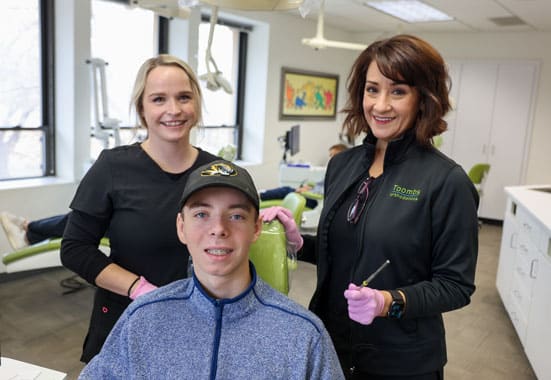
Surgical orthodontics may be used to treat adults with improper bites or other aesthetic concerns. Typically, jaw growth stops by age 16 in females and 18 in males. To receive orthognathic surgery, the jaw must be done growing. The need for surgical orthodontics occurs when the jaws do not line up correctly, and a proper bite cannot be achieved with orthodontic treatment alone. Orthognathic surgery will help properly align the jaw, and orthodontic braces will then be used to move the teeth into their proper position.
Why might I need surgical orthodontics?

At Toombs Orthodontics, Dr. Toombs may suggest orthognathic surgery to help:
Correct how your bite fits
Correct facial balance or asymmetry
Improve biting, chewing, swallowing, or speech
Minimize excessive tooth wear
Repair facial injury or genetic abnormalities
Provide relief for obstructive sleep apnea
You might also benefit from surgical orthodontics if you experience severe malocclusion, like an overbite, underbite, or crossbite.